Muller's suggested practice this week: use a sabbath box. A place to put the things that you carry around, and deliberately "let go" of the attended uses. Close the lid, and be done with them until it's time to deliberately pick them up again.
This one was easy for me. In my closet, on the shelves, there's a pretty wooden box with a cross on it that my mother gave me. It tends to gather clutter, but I cleaned that out and made places for the loose change and receipts and other little things.
Every evening, when I got home for the day, I went through the ritual of putting down my responsibilities. For those of you who are dying to know the regular contents of my pockets, here was the regular litany:
Wallet: I am through buying things today.
Wristwatch: I am on family time now. I have no other time-sensitive obligations.
Fountain pen (which goes in the other box, with all the other fountain pens): I am done writing, creating, preaching, and proclaiming today.
Vial of healing oil: I am always a priest, but I am done with my ministry for the day.
Class ring, seminary ring, clerical collar: I am finished being a visible minister of the gospel today.
Cell phone (turned off): I'm finished talking to the rest of the world today.
Keys to the church: I'm done with my job today.
it worked. I was really able to put things down and tell myself later, "nope, that's in the box. Go pick it back up if you want to work." I'll stick with this discipline for a few more weeks and see what comes of it.
24 December, 2006


18 December, 2006
Sabbath: silence
given that Muller's suggested sabbath exercise was to exercise a period of holy silence, I was tempted to make this a blank post. But, then again, two people would get the joke.
Silence is something I don't get a whole lot of, given that I have a five-year old in the house. I honestly tried to do some holy silence this week, but it didn't happen.
Two thoughts on silence:
First, I agree with Megan that Muller is thinking of the experience of shared silence. Most silences between people are at best uncomfortable, or else icy. Silence is often a negative thing. This sunday, I dropped the ball on the lighting of the advent wreath. We had a first-time acolyte (who did a fabulous job, and I discovered that he has a great singing voice) who was asked to go find the candle-lighter, and light it with matches, and go from place A to place B. I was supposed to help, and I forgot. Since all this action took place behind a pillar, the congregation didn't know what was going on, only that the presider was standing still and waiting. By the time I got to acolyte, his hands were shaking as he tried to light the wick and get out to his place. I bet the whole thing took 15 seconds, but it had the time-gets-multiplied factor that happens whenever there's unplanned silence.
By contrast, I arrived two or three minutes early one day this week for morning prayer. Our reader who leads morning prayer is a dear friend, and after a brief "good morning" we just sat together in companionable silence until he decided that it was time to start. He got up, opened his prayer book, and broke our moment of silence with "in the name of the Father, and the Son, and the Holy Spirit, amen."
Second, I've experienced a couple of evenings of keeping silence between dinner and breakfast, or between compline and morning prayers. That's been almost frustrating--it's not quite enough silence to let it settle in. Our seminary offered a week-long silent retreat, but I love the sound of my own voice too much and figured I'd come home in a straightjacket, so I never even tried to go.
Silence is something I don't get a whole lot of, given that I have a five-year old in the house. I honestly tried to do some holy silence this week, but it didn't happen.
Two thoughts on silence:
First, I agree with Megan that Muller is thinking of the experience of shared silence. Most silences between people are at best uncomfortable, or else icy. Silence is often a negative thing. This sunday, I dropped the ball on the lighting of the advent wreath. We had a first-time acolyte (who did a fabulous job, and I discovered that he has a great singing voice) who was asked to go find the candle-lighter, and light it with matches, and go from place A to place B. I was supposed to help, and I forgot. Since all this action took place behind a pillar, the congregation didn't know what was going on, only that the presider was standing still and waiting. By the time I got to acolyte, his hands were shaking as he tried to light the wick and get out to his place. I bet the whole thing took 15 seconds, but it had the time-gets-multiplied factor that happens whenever there's unplanned silence.
By contrast, I arrived two or three minutes early one day this week for morning prayer. Our reader who leads morning prayer is a dear friend, and after a brief "good morning" we just sat together in companionable silence until he decided that it was time to start. He got up, opened his prayer book, and broke our moment of silence with "in the name of the Father, and the Son, and the Holy Spirit, amen."
Second, I've experienced a couple of evenings of keeping silence between dinner and breakfast, or between compline and morning prayers. That's been almost frustrating--it's not quite enough silence to let it settle in. Our seminary offered a week-long silent retreat, but I love the sound of my own voice too much and figured I'd come home in a straightjacket, so I never even tried to go.
08 December, 2006
Sabbath: it is good
May the One who creates and restores all things
the One who is Mary's child and child of God
the One who is Holy Spirit
may this Holy One bless you, and fill your lives with joy
this is the blessing I'm using at the end of services during the season of advent. It was written/created/composed by Bill Adams, my liturgics professor.
Muller's chapter this week invites us to remember the fundamental goodness in creation. He says that one of the reasons we don't stop and rest is that we're afraid to be alone with ourselves or alone with the world, because we fear that the world is bad. Or that we are bad.
That's certainly the message that we get pounded into us on a daily basis. We're bad, or at best incomplete, unless we eat this thing/wear these clothes/drive this vehicle. We're not happy unless we watch this Christmas special on TV. Your kids won't love you if you don't buy them the Power Rangers Ulta Mega Bonzo Blaster. It's even true in politics: Vote for me, I'll make things better. Given the barrage of input, it's no wonder we forget sometimes.
The creation story on Genesis is set against a prevailing worldview that offered a story of a destructive, violent universe. It told a different version of the story, one in which the universe is deliberately spoken into existence by God, and that over and over and over God affirms that the physical world is good.
Muller's suggestion for a sabbath discipline this week is to bless people, either with or without their knowledge. Lay your hands on their head and offer a prayer, he suggests. Or do stealth blessings--just look at people who don't know you're praying for them and ask for God's blessing. In this action, you are reminded of their goodness, and of the goodness of creation... and that goodness is a moment of sabbath re-creation.
I guess that's the connection between the ideas on the chapter (i.e., remember the goodness of creation and let that goodness allow you the freedom to rest) and the suggested sabbath exercise (i.e., demonstrate that goodness). But I had trouble making the connection, and more trouble with this week's suggestion. I spent far more time and energy and thought on it than I'm sure he intended. What Muller probably sees as a casual thing, what is a shallow pool for him, is deep water for me, and for my community.
While every praying parent I know prays for their children, very few of those do so with an actual laying on of hands. As he described his suggested activity, I found myself imagining my father's and mother's hands on my head while they talked to God on my behalf, and I ached with wishing that I was remembering instead of imagining.
Here's the other thing. Blessing people in God's name is one of the things I'm asked to do on a regular basis. Those are, more often than you might think, transcendent moments, or "thin" moments, when it seems that the fabric of heaven is just within reach, out of sight, over your shoulder.
For better or worse, (and in many ways I think it's worse), blessing people in the context of liturgical worship is something reserved (in my faith tradition) for a priest. And I struggle with that. And Muller sent me into an exercise of re-examining blessing, with a good bit of unproductive tail-chasing thrown in.
One simple way to introduce the conversation (usually about the transubstantiation of the bread and wine at Eucharist, but extendable to people with only a little stretch), is to ask whether there is an ontological shift. If I make the sign of the cross on your forehead and ask God to bless you, or pronounce God's blessing on you, have you changed?
Well, welcome to a subject about which whole shelves of books have been written, by people smarter than me. But here's my answer, for the moment: My head says no, but my heart says yes. (or at least maybe)
The biggest reason my head says no is that I'm pretty sure I can't tell God what to do. But my heart remembers times in my life when I have been on the receiving end of blessings, and experienced, physically, emotionally, financially, relationally, what I can only describe in hindsight as the blessing of God. Moments of re-creation, what I imagine Muller is looking for.
Maybe, just maybe, this happens because God always wants to bless us. And if there is a person whose understanding of the world includes the idea that I'm allowed to bless them in God's name, then when they see me, hear my voice, feel my hands or fingers, then a little window cracks open for God's fresh air to blow through.
the One who is Mary's child and child of God
the One who is Holy Spirit
may this Holy One bless you, and fill your lives with joy
this is the blessing I'm using at the end of services during the season of advent. It was written/created/composed by Bill Adams, my liturgics professor.
Muller's chapter this week invites us to remember the fundamental goodness in creation. He says that one of the reasons we don't stop and rest is that we're afraid to be alone with ourselves or alone with the world, because we fear that the world is bad. Or that we are bad.
That's certainly the message that we get pounded into us on a daily basis. We're bad, or at best incomplete, unless we eat this thing/wear these clothes/drive this vehicle. We're not happy unless we watch this Christmas special on TV. Your kids won't love you if you don't buy them the Power Rangers Ulta Mega Bonzo Blaster. It's even true in politics: Vote for me, I'll make things better. Given the barrage of input, it's no wonder we forget sometimes.
The creation story on Genesis is set against a prevailing worldview that offered a story of a destructive, violent universe. It told a different version of the story, one in which the universe is deliberately spoken into existence by God, and that over and over and over God affirms that the physical world is good.
Muller's suggestion for a sabbath discipline this week is to bless people, either with or without their knowledge. Lay your hands on their head and offer a prayer, he suggests. Or do stealth blessings--just look at people who don't know you're praying for them and ask for God's blessing. In this action, you are reminded of their goodness, and of the goodness of creation... and that goodness is a moment of sabbath re-creation.
I guess that's the connection between the ideas on the chapter (i.e., remember the goodness of creation and let that goodness allow you the freedom to rest) and the suggested sabbath exercise (i.e., demonstrate that goodness). But I had trouble making the connection, and more trouble with this week's suggestion. I spent far more time and energy and thought on it than I'm sure he intended. What Muller probably sees as a casual thing, what is a shallow pool for him, is deep water for me, and for my community.
While every praying parent I know prays for their children, very few of those do so with an actual laying on of hands. As he described his suggested activity, I found myself imagining my father's and mother's hands on my head while they talked to God on my behalf, and I ached with wishing that I was remembering instead of imagining.
Here's the other thing. Blessing people in God's name is one of the things I'm asked to do on a regular basis. Those are, more often than you might think, transcendent moments, or "thin" moments, when it seems that the fabric of heaven is just within reach, out of sight, over your shoulder.
For better or worse, (and in many ways I think it's worse), blessing people in the context of liturgical worship is something reserved (in my faith tradition) for a priest. And I struggle with that. And Muller sent me into an exercise of re-examining blessing, with a good bit of unproductive tail-chasing thrown in.
One simple way to introduce the conversation (usually about the transubstantiation of the bread and wine at Eucharist, but extendable to people with only a little stretch), is to ask whether there is an ontological shift. If I make the sign of the cross on your forehead and ask God to bless you, or pronounce God's blessing on you, have you changed?
Well, welcome to a subject about which whole shelves of books have been written, by people smarter than me. But here's my answer, for the moment: My head says no, but my heart says yes. (or at least maybe)
The biggest reason my head says no is that I'm pretty sure I can't tell God what to do. But my heart remembers times in my life when I have been on the receiving end of blessings, and experienced, physically, emotionally, financially, relationally, what I can only describe in hindsight as the blessing of God. Moments of re-creation, what I imagine Muller is looking for.
Maybe, just maybe, this happens because God always wants to bless us. And if there is a person whose understanding of the world includes the idea that I'm allowed to bless them in God's name, then when they see me, hear my voice, feel my hands or fingers, then a little window cracks open for God's fresh air to blow through.
03 December, 2006
Sabbath: mindful breaths
I'm going to tell you something now that is universally true.
No kidding. Everyone reading this will agree with it, and probably every one you know will agree too. I live in a world of shades of gray, so I don't get to make blanket universal statements very often. Are you ready?
People are busy.
Am I right? Are you nodding your head? see, I told you.
There's busy, of course, and then there's busy. We are a nation of cell phone toting, overscheduled, overworked people. There's a reason Starbucks is so dang popular, and one of them is that we've become a nation of caffeine addicts, and we started drinking high-octane stimulants to keep ourselves awake and alert.
I started drinking coffee at university. Friday mornings are what I remember vividly. Friday mornings I had math, physics, and chemistry homework all due on the same day. In later semesters, it was materials science, structures, and vector calculus, but the same pattern existed. There were some Thursday nights I didn't sleep at all. Friday mornings, I would walk through the commons on the way to class, and emerge carrying three glazed doughnuts and the biggest paperboard cup that the food service had full of black coffee. (it was about the size of the venti at Starbucks these days.) That was just to try to keep myself awake through morning classes. I'd have done an IV drip of the stuff if I coulda figgered out how to do one.
But I digress, just a little. We were talking about overscheduled people with too-busy lives.
One of what I believe to be the core disciplines of a modern day disciple of Christ Jesus is Sabbath keeping. So when I read that one of the wisdom people in my life and one of her friends (who will probably become one of my friends when we finally meet) were doing a blogwriting exercise using the framework of the text Sabbath: Finding Rest, Renewal, and Delight in Our Busy Lives by Wayne Muller, I asked if I could play along.
On the heels of that request to play along, our parish administrator informed me that I had so much vacation time left this year that I probably couldn't use it all before the end of the year if I tried, since I hadn't taken but one vacation over the course of the year.
Oops. Sounds like somebody I know needs to practice some disciplines of sabbath keeping, huh?
* * * * * * *
This week, we're reading chapter 4 and doing the accompanying exercise, and reflecting on those. This week, Muller asks us to.... breathe. Stop and take mindful breaths, create spaces of rest and mindfulness in the midst of mundane tasks. For me, for the part of the week that I practiced the exercise, it was three mindful breaths while picking up a pen, uncapping it, and posting the end on the barrel.
I was immediately reminded of liturgics class. Bill Adams, our much-beloved teacher, would occasionally enter the room, sense the collective anxious busyness in our shared space, and gently ask, "do we need to exhale?"
Ah... yes. I remember now. This is a seminary. The church sent me here becase they want me to be a priest. I'm gathered in a room with a bunch of people I love very much. and isn't it beautiful outside?
And there would exist, for just a breath, a delicious moment of collective re-creation.
No kidding. Everyone reading this will agree with it, and probably every one you know will agree too. I live in a world of shades of gray, so I don't get to make blanket universal statements very often. Are you ready?
People are busy.
Am I right? Are you nodding your head? see, I told you.
There's busy, of course, and then there's busy. We are a nation of cell phone toting, overscheduled, overworked people. There's a reason Starbucks is so dang popular, and one of them is that we've become a nation of caffeine addicts, and we started drinking high-octane stimulants to keep ourselves awake and alert.
I started drinking coffee at university. Friday mornings are what I remember vividly. Friday mornings I had math, physics, and chemistry homework all due on the same day. In later semesters, it was materials science, structures, and vector calculus, but the same pattern existed. There were some Thursday nights I didn't sleep at all. Friday mornings, I would walk through the commons on the way to class, and emerge carrying three glazed doughnuts and the biggest paperboard cup that the food service had full of black coffee. (it was about the size of the venti at Starbucks these days.) That was just to try to keep myself awake through morning classes. I'd have done an IV drip of the stuff if I coulda figgered out how to do one.
But I digress, just a little. We were talking about overscheduled people with too-busy lives.
One of what I believe to be the core disciplines of a modern day disciple of Christ Jesus is Sabbath keeping. So when I read that one of the wisdom people in my life and one of her friends (who will probably become one of my friends when we finally meet) were doing a blogwriting exercise using the framework of the text Sabbath: Finding Rest, Renewal, and Delight in Our Busy Lives by Wayne Muller, I asked if I could play along.
On the heels of that request to play along, our parish administrator informed me that I had so much vacation time left this year that I probably couldn't use it all before the end of the year if I tried, since I hadn't taken but one vacation over the course of the year.
Oops. Sounds like somebody I know needs to practice some disciplines of sabbath keeping, huh?
* * * * * * *
This week, we're reading chapter 4 and doing the accompanying exercise, and reflecting on those. This week, Muller asks us to.... breathe. Stop and take mindful breaths, create spaces of rest and mindfulness in the midst of mundane tasks. For me, for the part of the week that I practiced the exercise, it was three mindful breaths while picking up a pen, uncapping it, and posting the end on the barrel.
I was immediately reminded of liturgics class. Bill Adams, our much-beloved teacher, would occasionally enter the room, sense the collective anxious busyness in our shared space, and gently ask, "do we need to exhale?"
Ah... yes. I remember now. This is a seminary. The church sent me here becase they want me to be a priest. I'm gathered in a room with a bunch of people I love very much. and isn't it beautiful outside?
And there would exist, for just a breath, a delicious moment of collective re-creation.
28 November, 2006
Call me Quasimodo
I always thought that it took a special kind of insanity to sit there, loudly ringing the same jangly bell, hour after hour after hour.
And then a friend asked me to do it.
Don't get me wrong, I like the Salvation Army. They almost never turn anyone away, and they deal with folk who walk in their door who live in places deep down you don't like to talk about at parties. Their transparency of finances is remarkable, and their fundraising percentage phenomenal.
So, anyway, my friend Gordon asked, and I went to help ring the bell last Saturday. He wrote about it here (including a picture of me--last one on the page).
* * * * * *
To answer your question, yes, my own bell dang near drove me crazy. To anyone with a musical ear, a small handheld bell becomes an irritant, like that one slightly flat piano key in the middle of the keyboard.
First you try ringing different ways: grasping handle firmly, like you're ringing a handbell in the church choir. Then with a little more fluid wrist action. then held loosely, dangling from between your fingers. Then with a stiff wrist, ringing from the elbow. Then repeat. I started to feel like the queen of the Rose Bowl parade. wrist, wrist, elbow, elbow...
Then you start experimenting with rhythm. Double rings are the easiest: ding-DING, ding-DING, ding-DING... Single rings with that kind of bell are harder, but you eventually get that down. Ding, Ding, Ding, Ding... Then, after some experimentation, if you hold the bell right, you can get triple-rings. Ding-a-ling, Ding-a-ling, Ding-a-ling.
Then I got creative. They give you a stick so you can push all those folded dollar bills down into the crack in the plastic kettle. So I started using the stick to make the bell ring. First on the bell itself, which sounds even worse... then on the wooden handle, whack-ding, whack-ding, whack-ding. After a few minutes of this, you discover where to whack the thing so it won't ring and will just give you a percussive sound. AHA! Rhythm!
Of course, you don't want to be too obvious about trying out your ringing technique. You're kinda in public. Kinda. But Gordon's right. There's a sense in which you blend in with the architecture and the elevator music, and you don't really exist for most people.
I did a one-man, stick-and-bell rendition of "O Come, O Come, Emmanuel." Then it was on to "Angels from the realms of glory." My perambulating audience seemed to take no notice of the remarkable artistry being displayed. Even tried a rendition of "Jingle Bells," even though I can't stand that song, because... well, yeah, it's a jingle bell. The good news was that nobody stopped to criticize my own little bizarre brand of holiday artistry.
So, anyway, give to the salvation army. They do good work.
And say hi to the bell ringer, even if you don't have anything to put in the kettle.
And then a friend asked me to do it.
Don't get me wrong, I like the Salvation Army. They almost never turn anyone away, and they deal with folk who walk in their door who live in places deep down you don't like to talk about at parties. Their transparency of finances is remarkable, and their fundraising percentage phenomenal.
So, anyway, my friend Gordon asked, and I went to help ring the bell last Saturday. He wrote about it here (including a picture of me--last one on the page).
* * * * * *
To answer your question, yes, my own bell dang near drove me crazy. To anyone with a musical ear, a small handheld bell becomes an irritant, like that one slightly flat piano key in the middle of the keyboard.
First you try ringing different ways: grasping handle firmly, like you're ringing a handbell in the church choir. Then with a little more fluid wrist action. then held loosely, dangling from between your fingers. Then with a stiff wrist, ringing from the elbow. Then repeat. I started to feel like the queen of the Rose Bowl parade. wrist, wrist, elbow, elbow...
Then you start experimenting with rhythm. Double rings are the easiest: ding-DING, ding-DING, ding-DING... Single rings with that kind of bell are harder, but you eventually get that down. Ding, Ding, Ding, Ding... Then, after some experimentation, if you hold the bell right, you can get triple-rings. Ding-a-ling, Ding-a-ling, Ding-a-ling.
Then I got creative. They give you a stick so you can push all those folded dollar bills down into the crack in the plastic kettle. So I started using the stick to make the bell ring. First on the bell itself, which sounds even worse... then on the wooden handle, whack-ding, whack-ding, whack-ding. After a few minutes of this, you discover where to whack the thing so it won't ring and will just give you a percussive sound. AHA! Rhythm!
Of course, you don't want to be too obvious about trying out your ringing technique. You're kinda in public. Kinda. But Gordon's right. There's a sense in which you blend in with the architecture and the elevator music, and you don't really exist for most people.
I did a one-man, stick-and-bell rendition of "O Come, O Come, Emmanuel." Then it was on to "Angels from the realms of glory." My perambulating audience seemed to take no notice of the remarkable artistry being displayed. Even tried a rendition of "Jingle Bells," even though I can't stand that song, because... well, yeah, it's a jingle bell. The good news was that nobody stopped to criticize my own little bizarre brand of holiday artistry.
So, anyway, give to the salvation army. They do good work.
And say hi to the bell ringer, even if you don't have anything to put in the kettle.
19 November, 2006
pretty words
Okay, there haven't been many posts recently.
Mostly because I've been sick. The creeping crud, I guess. My physician told me to get some sleep and take my vitamins, so we'll see.
The lack of posts is also because people haven't been asking for copies of sermons, and because I haven't been writing monthly articles. I didn't turn one in one month, and the ceiling didn't cave in. And then another month, and then they got used to life without my articles. I'm not sure anyone was reading the little things anyway. I'm also going to be undertaking a self-enforced blog writing exercise on Sabbath disciplines. stay tuned.
But today, I heard something blogworthy in the ubiquitous handshaking line after church.
Pretty words, Sonny, but don't change the liturgy.
The irony was that the sermon used as one of its two foundational texts the great sermon to the Hebrews, which says, in effect, "it's not about the liturgy."
These might have been the pretty words in question: "God's people are called not to preservation, but to proclamation. Not to immovability, but to agility."
Mostly because I've been sick. The creeping crud, I guess. My physician told me to get some sleep and take my vitamins, so we'll see.
The lack of posts is also because people haven't been asking for copies of sermons, and because I haven't been writing monthly articles. I didn't turn one in one month, and the ceiling didn't cave in. And then another month, and then they got used to life without my articles. I'm not sure anyone was reading the little things anyway. I'm also going to be undertaking a self-enforced blog writing exercise on Sabbath disciplines. stay tuned.
But today, I heard something blogworthy in the ubiquitous handshaking line after church.
Pretty words, Sonny, but don't change the liturgy.
The irony was that the sermon used as one of its two foundational texts the great sermon to the Hebrews, which says, in effect, "it's not about the liturgy."
These might have been the pretty words in question: "God's people are called not to preservation, but to proclamation. Not to immovability, but to agility."
01 November, 2006
C. Robinson, DFF
SAN ANTONIO (AP)-- It's become a tradition that championship teams get invited to the president's house. The Super Bowl champs get White House tours and ceremonies in the Rose Garden. This year, the ETSS Alumni Fantasy Football League honored last year's champion with a private ceremony at the Dean's office... in the basement.
In a Cinderella story almost beyond belief, the San Antonio Monsters rode a wave of utterly improbable coincidence into the playoffs.
In week 13 of the 2005-2006 season, the Monsters ended the regular season campaign with a crushing 111-46 defeat at the hands of the Dixie Dawgs, leaving the Monsters with a record of 5-8. While the Monsters were taking a first-class whupping, however, during the final game between the Delta Blues and Tennessee Blue Ticks, coach Chuck Culpepper benched star RB Shaun Alexander for the entire second half. Alexander was playing in the snow, and the coach later said he was worried about an injury. But Alexander, who the year before came up a yard short on the NFL rushing title, once again came up a yard short. One more yard would have meant one more fantasy point... and a change in the wild card bid to the playoffs. And so the Monsters, who were ready to pack their bags after a dismal season, found themselves in the playoffs.
As the TV ads kept saying, anything can happen in the playoffs. And happen they did.
Week 14 saw the Monsters pitted against the Zydeco ChaChas. The Chas watched with dismay as Fred Taylor, Donald Driver, Joey Galloway, and the Colts defense all collapsed simultaneously, giving the Monsters the win despite a zero-point performance by their starting quarterback. Tests on the affected players' pregame gifts of cookies (which arrived in brown-wrapper packages) ultimately proved inconclusive.
Week 15 saw the Dixie Dawgs contribute to the Monsters' improbable streak by choosing to use the Seahawks defense instead of the Ravens. Despite poor lineup choices at quarterback, running back, and wide receiver, the Monsters found themselves stumbling into the super bowl.
Super Bowl week, it was the West Coast Woozy Wockers' turn to lie down under the wheels of the Monster truck, as Uber-back LT2 scored a whopping 5 points. Monsters workhorse RB Corey Dillon limped into the end zone twice on national TV to seal the Monsters victory.
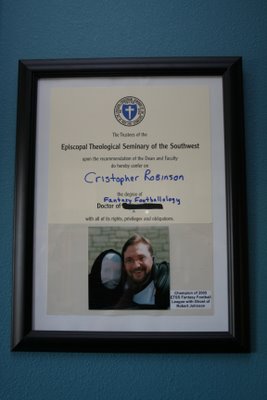
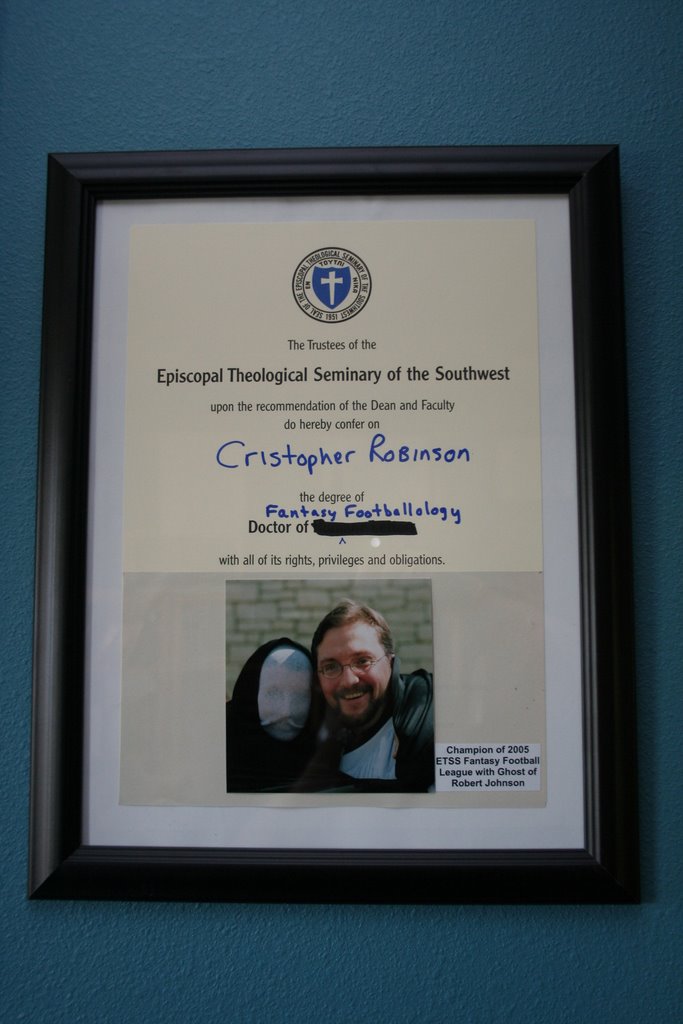
"Wow," said the bemused Coach Cristopher, "I ought to get an honorary doctorate for this."
And so, some nine months later, at a small but distinguished ceremony in the basement of the dean's office, Coach Cristopher was awarded the degree of Doctor of Fantasy Footballology, honoris causa. Former league champion Bob Kinney was there to hand out the honorary degree, give the graduation speech, serve the refreshments, take the pictures, sweep the floor, and lock up afterwards. "Don't know how the hell you did it," Bob said. "Musta sold yer soul to the devil."
In a Cinderella story almost beyond belief, the San Antonio Monsters rode a wave of utterly improbable coincidence into the playoffs.
In week 13 of the 2005-2006 season, the Monsters ended the regular season campaign with a crushing 111-46 defeat at the hands of the Dixie Dawgs, leaving the Monsters with a record of 5-8. While the Monsters were taking a first-class whupping, however, during the final game between the Delta Blues and Tennessee Blue Ticks, coach Chuck Culpepper benched star RB Shaun Alexander for the entire second half. Alexander was playing in the snow, and the coach later said he was worried about an injury. But Alexander, who the year before came up a yard short on the NFL rushing title, once again came up a yard short. One more yard would have meant one more fantasy point... and a change in the wild card bid to the playoffs. And so the Monsters, who were ready to pack their bags after a dismal season, found themselves in the playoffs.
As the TV ads kept saying, anything can happen in the playoffs. And happen they did.
Week 14 saw the Monsters pitted against the Zydeco ChaChas. The Chas watched with dismay as Fred Taylor, Donald Driver, Joey Galloway, and the Colts defense all collapsed simultaneously, giving the Monsters the win despite a zero-point performance by their starting quarterback. Tests on the affected players' pregame gifts of cookies (which arrived in brown-wrapper packages) ultimately proved inconclusive.
Week 15 saw the Dixie Dawgs contribute to the Monsters' improbable streak by choosing to use the Seahawks defense instead of the Ravens. Despite poor lineup choices at quarterback, running back, and wide receiver, the Monsters found themselves stumbling into the super bowl.
Super Bowl week, it was the West Coast Woozy Wockers' turn to lie down under the wheels of the Monster truck, as Uber-back LT2 scored a whopping 5 points. Monsters workhorse RB Corey Dillon limped into the end zone twice on national TV to seal the Monsters victory.
"Wow," said the bemused Coach Cristopher, "I ought to get an honorary doctorate for this."
And so, some nine months later, at a small but distinguished ceremony in the basement of the dean's office, Coach Cristopher was awarded the degree of Doctor of Fantasy Footballology, honoris causa. Former league champion Bob Kinney was there to hand out the honorary degree, give the graduation speech, serve the refreshments, take the pictures, sweep the floor, and lock up afterwards. "Don't know how the hell you did it," Bob said. "Musta sold yer soul to the devil."
Subscribe to:
Posts (Atom)


